MaS is about computer security, malware and spam issues in general.

2011/11/07

AnonCommunicate

I was intrigued by the various twitter feeds, allegedly owned by factions of the Anonymous group. Intrigued because it looked like the messages were encrypted. I asked the cryptographer Endre Bangerter, FH Bern/Biel, to help me out and he forwarded me to one of his reverse engineering wizards, David Gullasch (https://twitter.com/#!/x0n0x), who found out that it was not what I thought it was. Here's David's analysis:


The twitter account AnonCommunicate periodically tweets cryptic looking messages (apparently one tweet every 15 minutes). The stream of messages repeats every 537 tweets:

AAAAAA AAAAA4 NcPhvj VqKmBO lrbGYF WFvtYc 9FeFPl XAHsv8 cp7dLG VwJMht
sz7tNa OCDebL 3XyHL9 4NrD6b xCALJv RUoSl9 jpywkA 9JJg5Y cQSHam T4ACuG

MJGojD uarAAO QmkNiP DriWbM I9grRP Wsxlkw 7hdBSz vTRVKE 1U5CAK iua01m
DhcTSm pL8r7b podCXT JomI1N B4a6fD GbmlyA Gi18vQ 6qTikd rwHQZS 20l0pU

...

EcMt5A kEka05 5azHox uRhPlE Xh5PCm 28LjtL o5bzoe AAAAAG Mt1IvW bjfNp1
d6lLyZ iyJAKM quAT8w SuxpOj iAAAAA AAAAAA AABlta 7WXyEO ism4GD 7zKKwt

j0i8Ct Xl

The most obvious observation is that it consists of alphanumeric characters (a-z,A-Z,0-9), only. Therefore it can't be base64 encoded – more probably some sort of base62 encoding. Because log2(626) = 35.7251 is a somehow weird value, the six character blocking does not make much sense, if one assumes a binary encoding below the base62 layer.

The next observation come from the character frequencies: the character 'A' is much more likely to be encountered than any other character. This statistical anomaly does not stem from long runs of "AAA...A", these runs are only present in the first and last messages shown above. The many 'A' sprinkled all over the place turn out to be periodic and suggest a different blocking scheme as follows:

AAAAAAAAAAA4NcPhvjVqKmBOlrbGYFWFvtYc9FeFPlX

AHsv8cp7dLGVwJMhtsz7tNaOCDebL3XyHL94NrD6bxC
ALJvRUoSl9jpywkA9JJg5YcQSHamT4ACuGMJGojDuar
...
AEcMt5AkEka055azHoxuRhPlEXh5PCm28LjtLo5bzoe
AAAAAGMt1IvWbjfNp1d6lLyZiyJAKMquAT8wSuxpOji
AAAAAAAAAAAAABlta7WXyEOism4GD7zKKwtj0i8CtXl


Now the truncated final tweet "j0i8Ct Xl" also makes sense, because it exactly completes a 43 character block. Also log2(6243) = 256.03 is much, much nicer and suggests a base62 encoding of 256 bit blocks.

The third hint comes from the statistics of the second character in each block: it always is in the range A-O. Factoring in this fact and that the first character is always 'A', we get a block entropy of log2(15*6241) = 248.03, suggesting that one byte in an underlying binary 32 byte block must be fixed.

The next step is to find the correct base62 decoding. In the spirit of Benford's Law (integers are more likely to start with lower digits), we guess that 'A'..'Z' map to the values 0..25. Also, we guess that '0'..'9' and 'a'..'z' map to contiguous ranges. With these assumptions, the final parameters for the decoding can be found by trial and error:
'A'..'Z','0'..'9','a'..'z' map to 0..61 and the blocks are big-endian integers, which can be decoded like in the following example:

1. decoding the digits:

   A  A  A  A  A  A  A  A ...  t  Y  c  9  F  e  F  P  l  X
   0  0  0  0  0  0  0  0 ... 55 24 38 35  5 40  5 15 47 23


2. computing the integer value:

   0*6242 + 0*6241 + 0*6240 + 0*6239 + 0*6239 + ...
      ... + 40*624 + 5*623 + 15*622 + 47*621 + 23*620
   = 1107723835656471950689271297510666484906119194003614018861


3. repesenting that as big-endian hexadecimal integer:

   2D2D2D2D2D2D20424547494E2046494C45202D2D2D2D2D2D 


which obviously corresponds to the ASCII string:

   "------ BEGIN FILE ------" 


Decoding 31 bytes from every 43 character block in this way (and omitting the "------ BEGIN FILE ------" and "------ END FILE ------" strings) yields:


[Ed.: I've reduced this in size and converted it to JPEG format, so this isn't the original. - Morton]

So, it's not as nefarious as it seems. At least at first sight. I'm still exploring the phenomena, though :-)



2010/09/17

Getting an El-Al flight into the air


My bike commute to work leads me right along the München airport, so it's not difficult to notice that quite a few planes take off in the mornings. Looking at my watch while riding by, it looks like there are about 1 plane a minute taking to the skies. I managed to get off a little earlier this morning and noticed something new. The airport was quiet: no planes were taking off. So, I drove to the observation mound to see what was up. There was some ground traffic -- vehicles scurrying back and forth, but no planes in the air.
Then, one plane took off from the northern airstrip: an El Al flight and banked south, which is unusual as normally southbound planes leave from the southern strip. Very soon after that, about 5 minutes after, planes took off again at the regular pace. I also passed a police car that had been hiding in the bushes along my bike path.
So, I guess what happened was they cleared the airspace for that El-Al flight and probably had all other planes keep their distance on ground, too. They also probably had various police vehicles all over the airport zone checking in to get the tower the all clear, which is why there was nothing happening for such a long time.
What occurred to me after that take off is how much effort goes into creating such a secure flight and how it really doesn't scale well. If you've ever been on an El-Al flight you know what their passenger security procedures look like. On the ground, the flight get a police escort. The pilots are reportedly former military pilots and the planes are equiped with unusual but undisclosed defense systems. Now I realize that just getting that flight into the air (and probably landing it) is also very disruptive. It also makes El-Al probably the safest airline to fly on, but the model is probably overkill for other airlines.
(Picture from http://www.flickr.com/photos/67855182@N00/)

2009/04/16

6th VLDB Workshop on Secure Data Management (SDM) - extended

In Conjunction with VLDB 2009
Lyon, France
August 28, 2009

See also the official web site.

The 6th SDM workshop builds upon the success of the first five workshops (SDM'04, SDM'05, SDM'06, SDM'07, and SDM'08), which were organized in conjunction with VLDB 2004 in Toronto, Canada, VLDB 2005 in Trondheim, Norway, VLDB 2006 in Seoul, Korea, VLDB 2007 in Vienna, Austria, and VLDB 2008 in Auckland, New Zealand.

Deadline for paper submission extended:

May 1, 2009

Motivation

Although cryptography and security techniques have been around for quite some time, emerging technologies such as ubiquitous computing and ambient intelligence that exploit increasingly interconnected networks, mobility and personalization, put new requirements on security with respect to data management. As data is accessible anytime anywhere, according to these new concepts, it becomes much easier to get unauthorized data access. Furthermore, it becomes simpler to collect, store, and search personal information and endanger people's privacy. Therefore, research in the area of secure data management is of growing importance, attracting attention of both the data management and security research communities The interesting problems range from traditional ones such as, access control (with all variations, like dynamic, context-aware, role-based), database security (e.g. efficient database encryption schemes, search over encrypted data, etc.), privacy preserving data mining to controlled sharing of data.

This year, we will continue with a tradition to have a special session devoted to secure data management in healthcare. Data security and privacy issue are traditionally important in the medical domain. However, recent developments and increasing deployment of IT in healthcare such as the introduction of electronic health records and extramural applications in the personal health care domain, pose new challenges towards the protection of medical data. In contrast to other domains, such as financial, which can absorb the cost of the abuse of the system, healthcare cannot. Once sensitive information about individual's health problems is uncovered and social damage is done, there is no way to revoke the information or to restitute the individual. In addition to this, the medical field has some other specific characteristics, such as long-term value of medical data and flexibility with respect to, on one hand confidentiality, and on the other hand availability of medical data in the case of emergency.

Objectives

The aim of the workshop is to bring together people from the security research community and data management research community in order to exchange ideas on the secure management of data. This year an additional special session will be organized with the focus on secure and private data management in healthcare. The workshop will provide forum for discussing practical experiences and theoretical research efforts that can help in solving the critical problems in secure data management. Authors from both academia and industry are invited to submit papers presenting novel research on the topics of interest (see below).

Workshop Format

The workshop will be organized in conjunction with the VLDB conference. It is proposed to organize the workshop in conjunction with the VLDB conference.
Also, it is the intention to publish the proceedings in the Spinger-Verlag Lecture Notes on Computer Science series as it was done for the first four workshops. Additionally, we
also want to select the best papers with the intent to publish their extended and revised versions in a special edition of a journal (as it was done for the SDM 2006&2007 workshop with the Journal of Computer Security).
Topics of Interest

Topics of interest include (but are not limited to) the following:

- Secure Data Management
- Database Security
- Data Anonymization/Pseudonymization
- Data Hiding
- Metadata and Security
- XML Security
- Authorization and Access Control
- Data Integrity
- Privacy Preserving Data Mining
- Statistical Database Security
- Control of Data Disclosure
- Private Information Retrieval
- Secure Auditing
- Data Retention
- Search on Encrypted Data
- Digital and Enterprise Rights Management
- Multimedia Security and Privacy
- Private Authentication
- Identity Management
- Privacy Enhancing Technologies
- Security and Semantic Web
- Security and Privacy in Ubiquitous Computing
- Security and Privacy of Health Data
- Web Service Security
- Trust Management
- Policy Management
- Applied Cryptography

Paper Submission

Authors are invited to submit original, unpublished research papers that are not being considered for publication in any other forum. Manuscripts should
be submitted electronically as PDF or PS files via email to al_sdm05@natlab.research.philips.com

Full papers should not exceed fifteen pages in length (formatted using the camera-ready templates of Springer Lecture Notes in Computer Science http://www.springer.de/comp/lncs/authors.html). We also encourage submitting position statement papers describing research work in progress or lessons learned in practice (max six pages). Submissions must be received no later than May 1.

Each submission must be accompanied by a separate submission overview specifying the title, three keywords, author names with organizational affiliations, and must specify a contact author along with corresponding phone number, fax number, postal address and email address. The submission overview can be included in the body of the email. Each submission will be acknowledged by e-mail. If acknowledgment is not received within 3 days, please contact the organizers. It is intended to publish the proceedings in in the Springer Lecture Notes on Computer Science series. Additionally, we also want to select the best papers with the intent to publish their extended and revised versions in a special edition of a journal (as it was done for the SDM 2006 & 2007 workshop with the Journal of Computer Security).

2009/02/10

Computer Security Ontologies


Just by chance, I stumbled over a set of computer security ontologies that the US Navy Center for High Assurance Computing Systems has apparently been working on as a part of a SOA security project 4SEA. From that page:

The NRL Security Ontology was designed with the following objectives in mind:


  • Describe security related information applicable to all types of resources

  • Provide the ability to annotate security related information in various levels of detail for various environments (both commercial and military)

  • Create ontologies that are easy to extend and provide reusability

  • Facilitate mapping of higher-level (mission-level) security requirements to lower-level (resource-level) capabilities


It's a bit difficult to tell where they are going with this, but with the emphasis on web services, UDDI and MDA, it looks similar to Data Centric Security.

2008/12/17

CfC: Fifth International Summer School CfP

[PDF version]
Call for Contributions

Fifth International Summer School
organised jointly by the PrimeLife EU project
in cooperation with the IFIP WG 9.2, 9.6/11.7 11.4, 11.6.
Privacy and Identity Management for Life
(PrimeLife/IFIP Summer School 2009)
to be held in Nice, France, 7th – 11th September 2009


New Internet developments pose greater and greater privacy dilemmas. In the Information Society, the need for individuals to protect their autonomy and retain control over their personal information is becoming more and more important. Today, information and communication technologies – and the people responsible for making decisions about them, designing, and implementing them – scarcely consider those requirements, thereby potentially putting individuals’ privacy at risk. The increasingly collaborative character of the Internet enables anyone to compose services and contribute and distribute information. It may become hard for individuals to manage and control information that concerns them and particularly how to eliminate outdated or unwanted personal information, thus leaving personal histories exposed permanently. These activities raise substantial new challenges for personal privacy at the technical, social, ethical, regulatory, and legal levels:

· How can privacy in emerging Internet applications such as collaborative scenarios and virtual communities be protected?

· What frameworks and technical tools could be utilised to maintain life-long privacy?

The theme of this Summer School to be held in September 2009 and co-organised by the PrimeLife EU project and the International Federation for Information Processing (IFIP) will be on privacy and identity management for emerging Internet applications throughout a person’s life.

Both IFIP and PrimeLife take a holistic approach to technology and support interdisciplinary exchange. Participants’ contributions that combine technical, legal, regulatory, socio-economic, ethical, philosophical, or psychological perspectives are especially welcome.

Contributions from students who are at the stages of preparing either masters’ or doctoral theses qualifications will be especially welcomed. The school is interactive in character, and is composed of both keynote lectures and seminars, tutorials and workshops with PhD student presentations. The principle is to encourage young academic and industry entrants to the privacy and identity management world to share their own ideas and to build up a collegial relationship with others. Students that actively participate, in particular those who present a paper, can receive a course certificate which awards 3 ECTS at the PhD level. The certificate can certify the topic of the contributed paper to demonstrate its relation or non-relation to the student’s PhD thesis.

Topics of interest include but are not limited to:
- privacy and Identity management (application scenarios/use cases, technologies, infrastructures, usability aspects)
- privacy-enhancing technologies
- anonymity and pseudonymity
- transparency-enhancing tools
- privacy and trust policies
- privacy-aware web service composition
- privacy metrics
- trust management and reputation systems
- assurance evaluation and control
- privacy in complex emerging real-life scenarios
- the use of privacy-enhancing mechanisms in various application areas that are often life-long in character such as eLearning, eHealth, or LBS
- life-long privacy challenges and sustainable privacy and identity management
- privacy issues relating to social networks, social network analysis, profiling
- privacy aspects of RFID and tracking technologies, biometrics
- surveillance, data retention, availability and other legal-regulatory aspects,
- socio-economic aspects of privacy and identity management, and
- impact on social exclusion/digital divide/cultural aspects.

Contributions will be selected based on an extended abstract review by the Summer School Programme Committee. Accepted short versions of papers will be made available to all participants in the Summer School Pre-Proceedings. After the Summer School, authors will have the opportunity to submit their final full papers (which will address questions and aspects raised during the Summer School) for publication in the Summer School Proceedings published by the official IFIP publisher. The papers to be included in the Final Proceedings published by Springer (or the official IFIP publisher) will again be reviewed and selected by the Summer School Programme Committee.

Summer School Website: http://www.it.kau.se/IFIP-summerschool/

The submission address for extended abstracts (2-4 pages in length) will be accessible via the Summer School Website.

Submission deadline: May 14, 2009
Notification of acceptance: June 18, 2009
Short paper (up to 6 pages) for the Pre-Proceedings: August 11, 2009

General Chair:
Michele Bezzi (SAP Research/ France)

Programme Committee Co-Chairs:
Penny Duquenoy (Middlesex University/ UK, IFIP WG 9.2 chair)
Simone Fischer-Hübner (Karlstad University/ Sweden, IFIP WG11.6 vice chair)
Marit Hansen (Independent Centre for Privacy Protection Schleswig-Holstein, Kiel/ Germany)

Programme Committee:
Jan Camenisch (IBM Research/ Switzerland, IFIP WP 11.4 chair)
Mark Gasson (University of Reading/ UK)
Hans Hedbom (Karlstad University/ Sweden)
Tom Keenan (University of Calgary/ Canada)
Dogan Kesdogan (Siegen University/ Germany)
Kai Kimppa (University of Turku/ Finland)
Eleni Kosta (KU Leuven/ Belgium)
Elisabeth de Leeuw (Ordina/ Netherlands, IFIP WG 11.6 chair)
Marc van Lieshout (Joint Research Centre/ Spain)
Javier Lopez (University of Malaga/ Spain)
Vaclav Matyas (Masaryk University, Brno/ Czech Republic)
Martin Meints (Independent Centre for Privacy Protection Schleswig-Holstein, Kiel/ Germany)
Jean-Christophe Pazzaglia (SAP Research/France)
Uli Pinsdorf (Europäisches Microsoft Innovations Center GmbH (EMIC)/ Germany)
Andreas Pfitzmann (TU Dresden/ Germany)
Charles Raab (University of Edinburgh/ UK)
Kai Rannenberg (Goethe University Frankfurt/ Germany, IFIP TC11 chair)
Dieter Sommer (IBM Research/ Switzerland)
Sandra Steinbrecher (TU Dresden/ Germany)
Morton Swimmer (John Jay College of Criminal Justice, CUNY/ USA)
Jozef Vyskoc (VaF/ Slovakia)
Rigo Wenning (W3C/ France)
Diane Whitehouse (The Castlegate Consultancy/ UK)

Organising Committee Chair:
Jean-Christophe Pazzaglia (SAP Research/ France)

2008/11/24

Announcing the local New York chapter of the Heart Project

Although we haven't formally been accepted, I wanted to announce the formation of the local chapter of the Heart Project, which I've called "I heart New York". The idea is to participate in the development of an RDF store for Hadoop/Hbase. The main project is based mainly in Korea, which is just a bit too far for most people to travel, but there is quite a bit of interest in very large RDF databases here, so it seemed a good idea to have a local group. It will be attached to the NYC Semantic Web meetup group that Marco Neumann organizes, which is already one of the world's largest semantic web interest groups.
So, why am I interested, being the security geek that I am? Well, RDF and sematic web technology interests me in two ways. First of all, there is it's use in Data Centric Security. However, the other angle that I have is the encoding, exchange and reasoning over security relevant data expressed in RDF, or at the very least, using constrained (and well-defined) vocabularies. However, while looking at the amount of data that we at Trend Micro collect, I realized that no current system can handle it all. Furthermore, since we are working with a Hadoop infrastructure, it would be appropriate to leverage it. This led me to Heart.
If you are interested in the Heart project I'd encourage you to join in and if you are a New York local, then join our chapter, too!

2008/11/19

Metrocards and PII


So, I guess I'm not surprised, but Metrocards do contain ID information allowing the user to be tracked, see the New York Times article on a recent case. If you bought your card with a credit or debit card, then you can be identified, too.
I guess this has to be considered a normal infraction of our privacy nowadays -- along with credit cards, social security numbers, EZ-Pass fobs, ...

Sigh.

[picture by Darny, used under a Creative Common's license.]

2008/10/13

A few FCW Tournament photos

Hi all,

It's going to take a while to sift through all the photos I took at
the tournament and this is going to be a busy week for me. However,
I've posted a few photos from the trophy receiving ceremony for now.
It was already night when the Blue team finished their game (in the
dark) so I only have one photo available of them waiting for the
trophies. There are a few more photos of the White team and a group
photo with the trophies.

http://www.pbase.com/mswimmer/gallery/fcw_columbus_day_2008

Enjoy.

Cheers, Morton

2008/10/08


I was reading a New York Times article titled "Agency’s ’04 Rule Let Banks Pile Up New Debt". It is a pretty damning article on the SEC and describes a quiet decision made by them to allow investment banks to take on more debt than previously allowed under the assumption that the banks were able to  manage their risk better with their newfangled computer models. This allowed Bear Stearns (R.I.P.) to raise it's leverage ratio to 33:1, which seems extraordinarily high. Anyway, while reading it I stumbled over this paragraph:
A lone dissenter — a software consultant and expert on risk management — weighed in from Indiana with a two-page letter to warn the commission that the move was a grave mistake. He never heard back from Washington.
The software consultant was Leonard D. Bole, of Valparaiso, Ind. and he was expressing doubts that computer models could protect companies seeing that they had failed to do so in the collapse of a hedge-fund in 1998 and the market plunge in 1987. While I have my doubts that any computer model can calculate risk well enough and certainly increasing allowed leverage ratios seems just plain daft, I think the current credit crisis is now just down to trust. Or the lack of it.
So, if it is a trust problem, how would a computer scientist approach the problem? First of all, I need to point out that trust is really a human issue, so there is a limit to how much computers can help, just as I doubt we can model risk. However, one of the problems is that there is a certain degree of mortgages that are of too high risk, but banks don't know what their exact exposure is, let alone that of their competitors. The result is that no one trusts each other and the capital market has suffered a form of seizure or heart attack.
A couple of years I was leading a project exploring Data Centric Security and as a part of my research I looked into provenance. We never had time to weave it into the model properly, but identified it as an important aspect that eventually needed to be included. But, wait. What is provenance?
Take paper. Paper documents have great provenance. You fill out a form, hand it in. It gets handled, gets coffee stains over it, stapled to other documents, stamped, filed, refiled, etc. By examining a paper document you get a feeling for where that document has been and what it went through. That is provenance. 
Unfortunately, electronic documents don't have provenance out of the box. Luckily, there has been some research into how provenance can be added. The project I was exposed to at IBM Research was the EU Provenance Project that was a part of the European Commission's Sixth Framework Programme, bless their cotton socks. Their proposed architecture, if I remember correctly, was to place hooks in document processing which record document use (CRUD operations: create, read, update, delete). Though I'm not sure if that is the way I would have done it, it certainly work work unless someone cheated or didn't implement the hooks, though I assume that would be uncovered the next time the provenance recording system saw the document. 
How would provenance help in the credit crisis? If we just isolate the problem of sub-prime mortgages (and my brother, who knows much more about the financial industry assures me that there are a whole pile of other problems) it does look like a provenance problem to me. From my perspective as an outsider, what seemed to be happening was that these sub-prime mortgages were being sold, repackaged with other debt, sold again and so on. In the end, the last one in the chain didn't know what he/she was actually getting. The lack of provenance of these aggregate debt packages meant it wasn't possible to sufficiently well calculate what the risk was (in itself a dubious thing, but made even more difficult in this case.)  
Remember that all financial instruments is really just a document of sorts that we attach a value to. The document has no intrinsic value. Take currency: The dollar bill has no real value. You can't eat it. It doesn't produce a lot of energy when burned. However, we place a certain amount of trust in it as the intricate design and the type of paper tells us that it comes from a trusted source: in this case the US Treasury. The provenance of this bill allows us to accept that the risk is low that the extrinsic value is not one dollar, US. 
When aggregating debt from multiple sources you need to collect the provenance of all the included debt documents. This allows you to better estimate the risk associated with the aggregate debt and also find inconsistencies that I really really hope dont exist like circular provenance (which would be similar to a Ponzi scheme.) It also would allow the banks to identify the bad parts of the debts and calculate their exposure, which is something that they don't seem to be able to do at the moment. If they could, they would probably find that the bad debt they own is not as bad as it could be and there would be less uncertainty. Amongst other things, it is the uncertainty about the exposure to bad debt that has resulted in the credit crisis. 
While not all the problems that banks are facing can be solved by computer scientists or mathematicians, and you can argue that we have been instrumental in getting us into this mess, provenance standards for financial documents would go a long way to alleviating the problems we have at the moment.

2008/10/05

I survived VB 2008

The Virus Bulletin Conference is probably the most important anti-malware conference there is. It is also the oldest surviving. I have been attending only since 1995 as it was just too expensive as a student. 
This year, it was in Ottawa, Canada's capital. The conference switches sides of the Atlantic every year, but since 2001, it is not possible to hold it in USA because some delegates can not or will not travel to the US. That said, Canada is a great place to go to, though VB is starting to run out of likely venues. 
There were no real eye-openers in the presentations I saw, but there was a constant flow of useful snippets of information. Luckily, my talk was the first after the keynote, so I could enjoy the rest of the conference. 
The real value of this conference, as with nearly every one, is the networking one does. I had quite a few hallway chats with delegates and speakers, and I've come to realize that these chats are what makes the industry function. It builds trust in an industry where misplaced trust could be dangerous. 
What I really noticed this year was that photography seems to be a very popular hobby. I've put my own photos on pbase, but thought it might be fun to start a flickr vphoto group for the amateurs in the anti-virus industry. (I actually prefer pbase for more serious work, but more people are already on Flickr.)
So, not after four 18 hour days and too much food and alcohol, I'm in rehab mode. It was fun, but I'm glad there is only one VB conference a year.

I confess to world domination

Graham Cluley, of Sophos, filmed various anti-virus researchers on a variety of silly subjects at the Virus Bulletin 2008 conference. I was one of them. I'll have to confess that I was one of the few to see the questions beforehand, so I knew what was coming. In the spirit of things, I decided to be totally silly about it. Enjoy. Or cringe. Your choice.

2008/09/27

We may be losing


Yesterday (26. Sept. 2008), I was on a panel at the Polytechnic institute of NYU to discuss targeted malware. I chose the title above for my introductory talk to be provocative, but, in truth, the security is in reactive mode and is slow even doing that. I wanted to outline what I thought are the problems in a nutshell and what the intended interdisciplinary audience could be thinking of doing about them. Because I was trying to stick to my alloted 5 minutes, I didn't get through all the material, so here is what I was trying to communicate:

Problems

The tendency to overcomplicate design

We overcomplicate systems in two ways: (1) in engineering we seem to want to use the hammer that we know and treat everything as a nail. We are also very much caught up in a legacy mode to thinking. OSes like OS390, Windows, Linux are examples. The same thing goes for application frameworks. We try to shovel every problem into these without thought of if this makes sense. This results in overcomplicated designs that are impossible to understand and audit. (2) The systems are also very hard to actually understand for the user. We design the UI in a way that hides the internals and is alien to how people think the system is going about its business. The fact that a spammer can abuse the email sender field is a total HCI failure.
Furthermore, we never seem to consider security and privacy in the initial design. “Let’s get this out first, and see if people like it.” We lived with Macro viruses for such a long time because Microsoft thought that macros in documents might be a good idea. Only when they disabled running macros in documents by default did the problem largely disappear - and no one thought it was a big loss.
User education continues to fail as we can barely explain things to each other, let along to non-technical users. Also the landscape continues to change too quickly. For the longest time, I would say that documents could not be infected, hoping that it would stay true even when we were aware of the possibility. And then WM/Concept hit the scene in 1995...
We are fighting an ecology of cyber criminalsThis is not about ‘one criminal’ or ‘one gang’. There is a vast network of service providers that the principle perpetrator uses for nearly every aspect of the crime. It is a surprise that they have not adopted a SOA architecture yet. For law enforcement, it is extremely difficult to find every party involved and then usually find that many of the actors are out of their jurisdiction and the principle perpetrator is heavily shielded.
The 80/20 rule seems to apply. They can get the most profit out of perhaps 20% of the potential targets. These are the people who have not updated their systems and kept it secure enough. I would like to say they must be gullible, but these attacks have become very sophisticated and not enough has been done to make it easy to spot the deception. There are also attacks against high-valued targets, but these are rare for a variety of reasons. First of all, economies of scale are not favorable, and because of the methods used, the perpetrators are more easily traced. These attacks exist and are probably being used in IP theft and patriotically motivated citizen cyber warfare (e.g, Estonia and Georgia).
Security vendors unfortunately have the same problem. They have to go after the 20% of the potential vulnerabilities they they feel will be responsible for 80% of the attacks. Covering all bases is impossible and the landscape is constantly changing anyway. I know this because I typically look further down the pipeline than most.
The trick is to make it not worth the criminal’s while. If a bank can limit the potential payout, make it inconvenient enough or create a mandatory delay in processing to give law enforcement an edge, they will move elsewhere. You still have to be vigilant as you don’t want to become the low-hanging fruit.

Dealing with the problem

System and service providers must assume the risk

EULAs and Terms of Use typically release the system provider from any responsibility to produce secure software. This is a mistake and probably shouldn’t be legal. A system of insurance for managing risk should be instated to deal with the security risks in the software as the insurance industry has a lot of experience dealing with risk mitigation and will find a good balance.
There is a desperate need to over engineer software w.r.t. security especially. The problem is that current economics don’t encourage this practice. It is hard to become a car manufacturer because creating a car to withstand all the stresses on a car is something gained through long experience. But failure to do so is no longer tolerated: there are regulations and litigative pressures to do ones best. Also interestingly, regulation doesn’t specify methods, but outcomes. While I don’t like the car analogy too much, I think similar ideas can come to play in the software industry.
Brittle in this context means that your system interaction will not break down into an inhuman experience when things go wrong. It shouldn’t dissemble when confronted with unusual input. The failure mode should be rooted in common sense. System design must be rooted in human expectation and not just on machine feasibility.

Reactive Security

Lastly, security need to become reactive - and it’s not reactive enough. Diagnosis needs to occur much closer to the user so that timeliness and context is not lost. At the moment, malware is collected in an ad hoc fashion, signatures are created and deployed. The time between a threat being deployed and detected is far too long. We tried to fix this with the Digital Immune System, but tragically it never was deployed as expected and is now dead with no apparent replacement. Perhaps better solutions are still being shunned by customers as they are often heuristic based, and traditional solutions are preferred as they are perceived as having a more deterministic outcome. However, this is faulty thinking. The variety of solutions have to work together in concert, but for this to happen, they must understand each other.

This is pretty dense, but even though I compressed it even further when speaking, I think I may have gone overtime. Of course, so did everyone else, so there was not really enough time left for a proper discussion. But in the breaks and over lunch and dinner these topics came up again and again.
It was a great workshop and fun to meet old friends and make new ones. Thanks to the organizers who put it together. It would be interesting to attend the next time, too!
For students, there is a similar workshop held nearly every year and organized by IFIP: the IFIP Summer School on Security, Privacy and Society organized by IFIP WG 9.2, 9.6/11.7 and 11.6. The last one was in the Czech Republic. As a student, you can get credit for participating.

2008/09/23

UPDATED: Workshop on Interdisciplinary Studies in Security and Privacy

On ThursdayFriday Sept. 26, I'm going have to get up unbelievably early to get to a panel on Targeted Malware at the Workshop on Interdisciplinary Studies in Security and Privacy hosted by the Polytechnic Institute of NYU. Gosh, was that gratuitous or what?
The panel position statement begins with:
Malware undermines trust in information systems. To a certain extent, our success as information system engineers can be measured in terms of the amount of trust that society puts in the systems we have built. Malware, therefore, threatens our success, hinders the acceptance of technologies, and could even potentially reverse the progress that has already been made. The situation is not purely technical. Improved technology can sometimes help (e.g., better software quality), but practical solutions to current and future problems with malware will likely involve a mixture of techniques from multiple areas.
I think I can go along with most of that. Luckily, there are points later in the test where I deviate in opinion, so it should be interesting. 
Anyway, it will be nice to go back to what was once the Brooklyn Polytechnic, where I spent a while shepherding a very interesting project that Prof. Phyllis Frankl was leading. I can't tell you what it was, except it was cool new malware detection technology that never made it into a product as Symantec bought IBM AntiVirus around that time and apparently weren't interested, but it did influence my further research.
If anyone wants to attend the panel (please leave the rotten fruit at home), you have to be invited and you can try your luck on the registration page.


For reasons I can't explain, I had Thursday marked down in my calendar and not Friday, which is the correct date. I'll blame it on the financial crisis :-)

2008/07/18

DARPA wants to make soldier more easily targetable

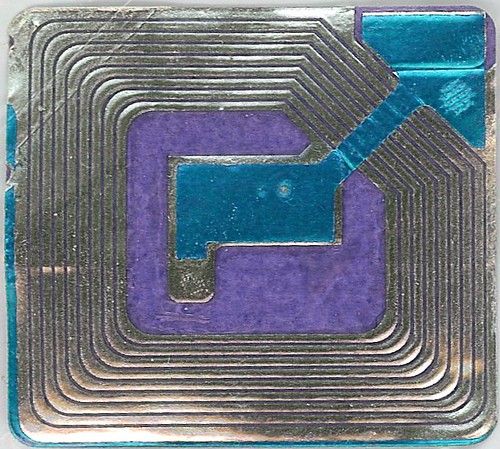
A very long time ago - nearly another life ago - I helped a military contractor who had a security breach try to see what the scope of the breach was. In the process I learned quite a bit about battlefield communications. So, you can imagine my surprise to read this article in The Register about outfitting every soldier with a long distance readable RFID tag (not the type in the picture on the right, by the way). Readable from 150 km, no less! Considering all the pains the contractor I worked with went through to prevent any form of RF to be emitted, I find this technology rather bizarre. 
I could imagine the tag being useful for training and maneuvers. I could also imagine it being useful as a last resort for a soldier to be located when lost or wounded in theater and to be fair, in the referenced presentation it mentions (once) that the tag is 'inert', which may mean that it needs to be activated before it sends a beacon. That might be an acceptable application.
What worries me is that UAVs are now so cheap and accessible that I could easily imagine even small states being able to afford a small fleet of UAVs that swarm over enemy troops in theater and home in on these tags. Or other forms of identifiable RF radiation, such as from a FCW Land Terminals. 
I hope they know what they are doing, but I have my doubts.

2008/07/17

Insider hacks own system


ABC reports that a San Francisco employee created "virtually exclusive access to most of the city's municipal data." And I thought those days were long gone when that would be possible. 
However, it doesn't sound like something that a good computer forensics expert couldn't solve.

2008/07/04


I really like this idea from Symantec: paper-based malware. Somehow this way of raising awareness of the problems of bots appeals to me.
I can't be sure that ideas like that really work, but one can hope. Anyway, better to have a bot next to one's PC than in it!
But what's with that Norton Today site? No RSS feed? Come on! 

2008/06/03

Semantic Web Meetup June 1, 2008


What would you do on a day of perfect weather in New York City? Attend an all-day code camp on Semantic Web programming in Brooklyn of course! OK, I guess I would have preferred it to be a rainy day if I had to be inside, but it still was worth it. I learned a lot about Semantic Web programming and more importantly, realized that the technology is closer to being reality than before. This is a report on what I learned.
The event was organized by Marco Neumann and hosted by Breck Baldwin of Alias-i. After bagles, that Marco had brought along, and introductions, a brief run-down of some of the concepts and technologies was given. This was followed by quick descriptions of the projects we were to tackle at the meetup. After a rather late lunch we chose our projects and had a few hours to complete them. In theory, we were supposed to use the Extreme Programming paradigm, but that devolved a bit into group programming interspersed with discussion. 
I don't really want to go into the projects in detail. I was interested in two of them, the Natural Language Processing project headed by Breck, our host, and a spatial reasoning projected headed by Marco. The actual projects were not that important really, though, instead the programming aspects were. I was at a disadvantage as it turned out that Java is king when it comes to semantic web programming and I've been doing my programming in Ruby and Erlang for over a year. Semantic Web support for Ruby is not great and not really existent on Erlang. 
In Java, the way to go was to use the Jena library. Jena started at HP, but in the intermediate time had become a sourceforge project. It now offers support for RDF, RDFS, OWL and SPARQL. It also supports reading and writing the RDF in RDF-XML, N3, N-Triple and I believe also Turtle. There was some discussion of the strengths and weaknesses of these formats. The rough consensus was that N3 and N-Triple are more human readable, but RDF-XML is more expressive, at least from a syntactical standpoint. It wasn't clear to me if there was any semantic difference. In the NLP project, Jena was used to emit RDF, initially in N3 format, though that was quickly changed to RDF-XML. Once that was done for a subset of the data, a SPARQL query was hacked together (again using Jena) that used that file. All in all, it required not that much real code, though given that it was Java there was all sorts of fluff surrounding it. 
On a side note, one of the participants showed us some of his Groovy code, and I must say that Groovy might get me back in Java again. It's like a less wordy version of Java, or perhaps a Java that has been put on a diet by the Ruby camp. When Groovy is mentioned, I guess you have to mention Scala as well. Both seem to be taking Java beyond the confines of the actual language, Java, by leveraging Java, the virtual machine and all the libraries that are available as Jars. 
Apart from the programming, there were a few other things I picked up. In the past I had been using Protegé. However, apparently this is no longer the way to go. A company called TopBraid Composer, which is based on the Eclipse platform and Jena has usurped Protegé from its throne. Apparently it is free for non-commercial use, though that is unclear from the website as it does say that you need to purchase a license after 30 days. 
One of the other projects was looking at transforming a relational database into an RDF database using D2RQ. There was a paper at W3 that describes this idea. From what I gather, this is nearly equal to trying to derive semantics from database schemata - not something that can really be mechanized. There are also all sorts of performance issues that will have to be addressed if a production database were to be stored as an RDF database, but perhaps this is too early to discuss those issues as we first need to understand why we need them this at all. If it means that we can elevate the data in a database to the level of information, this might be worth it, though. Since there seem to be all sorts of expressivity issues when comparing traditional databases to RDF stores, perhaps the right thing would be to develop new application based on RDF first and only then try to transform existing databases. 
Another subject that came up was the difference between ABox and TBox reasoning. ABox reasoning is based on assertions on individuals (ie, the rows of data, to use a database table analogy) whereas TBox reasoning is based on concepts (ie, the schema of a database table).
So, what does all this have to do with security? There are two aspects of this. 
  1. The security of the Semantic Web metadata
  2. Using Semantic Web technology to secure our data
The first aspect is certainly not a trivial one. Metadata has already caused embarrassment to many people including Tony Blair when people don't realize that there is more data in a typical document than (literally) meets the eye. In computer forensics, this is what we live for. However, as more webpages get semantic data attached to them, more data may be transmitted than gets shown to the user and now it can be read automatically. Privacy advocates will be all over this problem, but corporations will have to pay attention, too. 
However, what I am more interested in is the use of this metadata and the technologies of the semantic web to define and enforce security. At IBM, this is called Data-Centric Security and as far as I can tell, they are working on database security using taxonomies for classification. What the NLP projected showed me is that to some degree, we could also create a content based security system at some point in time. Alias-i and OpenCalais might be the key.
What the code camp showed me is that the technology has reached the point that it is usable. While security is nearly never a business case in itself, there will be other, more motivating, reasons to use semantic metadata in corporations and that will enable such ideas as DCS.

2008/05/02


I just read about a canadian bank handing out ASUS EEE PCs. Now, a while ago when dealing with a Bank phishing case, I suggested that hypothetically, a bank could offer a simple laptop to their customers solely to do banking with. Of course, that is a problematic proposition that one single bank may not actually want to venture into on its own. We went over perhaps more practical solutions like booting from a Knoppix-like CD that could only be used for bank transactions as well as using a VMWare image. None were adapted, of course.


Now RBC is offering a free ASUS EEE PC as an incentive, but I keep on thinking that having a dedicated cheap laptop would be a good idea for the general population. The EEE is a small and basic Linux system, but supports one important thing: a browser useful for e-banking, Firefox. While I'm not a fan of remote attestation on practicality grounds, I could see it working in this case of a dedicated e-banking machine.


Would banks want to get into this business? I don't think so. However, an enterprising company might be able to convince enough banks to offer such a device to their customers and offer the security maintenance of such systems as a service.

2008/04/22

Virus calendar


Gosh, what a blast from the past. Way, way back in the annals of time it was actually possible to analyze malware (OK, viruses mainly) well enough to know all trigger dates of their payloads. So, I thought I'd create a virus calendar. I think the first was created for the year 1990 or 1991 for the Virus Test Center so that we'd have something fun to show at expos like CeBIT. Then I got a commission to create one (and later another one) for perComp Verlag which they dug up recently and posted on their site for the years 1992 and 1993. While the 1992 version was mainly my work, I think I only contributed data and ideas to the 1993 version. Apparently some people in Germany still show excerpts of these calendars in presentations, though I shudder to think why. I think S&S International Ltd, UK also created a few calendars based on their own data and graphics, but after 1995 it became impossible to analyze all known viruses and even if it was possible, it would have been one crowded calendar!
This is one rare moment, where I was able to do something graphical in the context of computer security.
I think when I get back home, I'll dig out the original and scan that in, too!